No Signal Required: Portraits of Travelers Who Still Find Their Way the Old Way
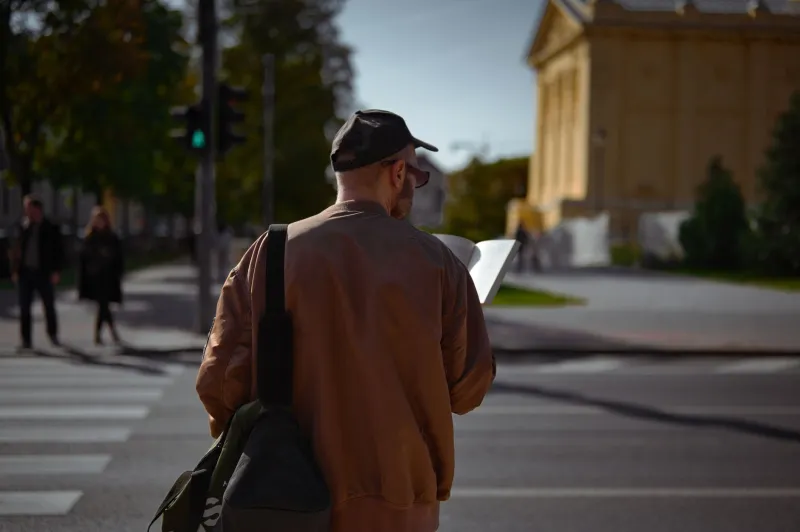
Denise Hartley has been to 47 countries. She doesn't own a smartphone.
This isn't a statement she makes with pride, exactly — more like a shrug, the way you might explain that you still prefer physical books or that you've never gotten around to learning to drive. For Hartley, a retired high school geography teacher from Flagstaff, Arizona, traveling without digital navigation isn't ideology. It's just how she's always done it, and she's never found a reason compelling enough to change.
"I ask people," she says, simply. "That's basically the whole system. You ask someone, they point you somewhere, you go there, and then you ask someone else."
She is, by any reasonable measure, an anomaly. In 2024, the vast majority of international travelers navigate primarily by smartphone — Google Maps, Apple Maps, Maps.me for offline use. The apps are good. They are often genuinely excellent. And they have made travel more accessible, more efficient, and more predictable than any previous generation would have thought possible.
But a small, scattered community of travelers — some ideological, some habitual, some just stubborn — continues to move through the world without them. And what they describe finding, in the gaps between coordinates, is worth paying attention to.
The Conversation as Navigation
Marco Fiore, a 34-year-old furniture maker from Denver, took his first solo international trip at 22 with a paper guidebook and a pocket phrasebook. He's taken twelve more since then the same way, including extended trips through rural Vietnam, northern Ethiopia, and the interior of Mexico.
His method is what he calls "chained directions" — you ask someone how to get somewhere, you follow their directions until you're lost or uncertain, and then you ask the next person. Each exchange is a small conversation. Most conversations go somewhere unexpected.
"The best meal I've ever eaten in my life came from a woman in Oaxaca who I asked for directions to a restaurant that was recommended in my guidebook," Fiore says. "She told me that place had closed two years ago and then invited me to her cousin's birthday party. I ate with about forty people I'd never met in a courtyard behind a tire shop. There's no algorithm that leads you there."
This is the story analog travelers tell most often — not the dramatic discovery, but the accidental invitation. The conversation that started as a practical exchange and became something else. The friendship that formed because you were confused and visible and a person rather than a dot on a map.
Digital navigation, for all its utility, tends to make travelers invisible. You follow the blue line. You arrive. You were never really present in the space between.
What the Body Knows
Rachel Song, a 41-year-old landscape architect from Portland, Oregon, has a different relationship with analog travel. She's not anti-technology in principle — she uses it constantly in her professional life. But she made a deliberate choice about eight years ago to leave her phone in her bag during the actual walking portions of her trips.
"I noticed I was experiencing cities through a screen even when I wasn't taking photos," she says. "I was looking at the map on my phone instead of looking at the street. I was so focused on not getting lost that I wasn't actually seeing where I was."
What she developed instead is something she describes as spatial intuition — a practice of reading cities through their physical logic rather than their digital representation. Older cities tend to organize around water sources, market squares, and religious buildings. The streets that are wider and better maintained usually lead somewhere important. The smell of bread or coffee or food markets is directional information. The angle of the sun tells you which way is west.
"You start to feel the shape of a city," Song says. "Not perfectly — I get turned around constantly. But the getting turned around is part of it. You see things you would have driven past."
Urban designers have a term for this: legibility. It refers to how easily a city can be understood through its physical form — its landmarks, its districts, its edges and nodes. Jane Jacobs wrote about it. Kevin Lynch built a career studying it. Digital navigation, some urban researchers argue, is quietly destroying our ability to read it, because we no longer need to.
The Philosophical Case
Not everyone who travels without GPS is casual about it. Some have worked out a full argument.
James Okafor, a 52-year-old writer and former foreign correspondent from Atlanta, spent years traveling for work with every digital tool available. Then, during a long trip through West Africa that he was making purely for personal reasons, he left the apps behind as an experiment. He never went back.
"Digital navigation gives you the destination but removes the journey," he says. "And I don't mean that in a bumper-sticker way. I mean it literally. The route becomes irrelevant — just an obstacle between you and the pin. When you navigate by feel, the route is the experience. There's no obstacle. It's all the thing."
Okafor is careful not to romanticize the difficulties. He's been genuinely lost in ways that were stressful and occasionally frightening. He's missed things he wanted to see because he couldn't find them. He's wasted hours backtracking.
"But I've also never once arrived somewhere and felt nothing," he says. "When you find a place by working for it — by asking and guessing and turning around and trying again — it belongs to you in a way that a dropped pin never does."
What Gets Lost. What Gets Found.
It would be dishonest to argue that analog travel is simply better. It's harder, slower, and more likely to produce frustrating dead ends. It requires a tolerance for discomfort and uncertainty that not every traveler has or should be expected to have. Accessibility matters — for travelers with disabilities, with limited time, with language barriers, digital navigation is often not a luxury but a necessity.
And the serendipity that analog travelers celebrate isn't exclusive to them. Plenty of people using Google Maps have stumbled into extraordinary moments. The app doesn't prevent curiosity. It just doesn't require it.
But there's something the analog travelers are pointing at that's worth sitting with. The efficiency that digital navigation provides comes with a trade — a compression of experience, a smoothing-out of the friction that used to force interaction. When you can't ask your phone, you ask a person. And that person, more often than the statistics would suggest, turns out to be the whole point of the trip.
Denise Hartley, the retired teacher from Flagstaff, puts it plainly: "I've never once looked back on a trip and remembered the times I got somewhere efficiently. I remember the times I got lost and someone helped me find my way."
The coordinates were never really the destination.